San Pedro de Alcántara Area Guide
San Pedro de Alcántara sits between Puerto Banús to the east and Estepona to the west, just inside the Marbella municipal boundary. For decades it was a functional Spanish coastal town — a place people drove through on the way between Marbella and Estepona, with a distinct older character and less of the resort gloss of Marbella proper. Then the A-7 coastal highway, which cut directly through the centre, got buried underground — and the town got its seafront back. This guide covers San Pedro's history, its re-shaped centre, and its property market.
1. San Pedro in one paragraph
San Pedro is the most genuinely Spanish of the Marbella-area coastal towns. It's functional rather than flashy. The old town has a working plaza, pedestrianised shopping streets, a Sunday flea market, and restaurants that mostly cater to locals rather than tourists. The 2014 boulevard project — built over the buried coastal highway — gave the town a proper central green spine that connects the old town to the beach. The property market here typically prices 10–20% below equivalent Puerto Banús / Marbella core stock.
2. History: a 19th-century colonial founding
San Pedro de Alcántara was established in the mid-19th century as an agricultural colony — its grid-plan old town layout reflects that planned origin rather than organic medieval growth. The main pedestrian street, Calle Marqués del Duero, is named for the 19th-century noble figure associated with the town's founding. Traces of the colonial past remain visible in the town plan: the straight streets, the central plaza around the Iglesia de San Pedro, and the grid geometry that distinguishes San Pedro from the more winding layouts of older Andalusian towns.
3. The boulevard: burying the coast road
The defining recent project in San Pedro — and one of the largest single infrastructure projects on the Costa del Sol in recent decades — was the burial of the A-7 coastal highway beneath a new surface park/boulevard.
Key facts, per The Olive Press and other sources:
- Length: 1,075-metre tunnel, as part of a wider 5,950-metre project stretching from southwest of San Pedro to the outskirts of Puerto Banús
- Cost: approximately €85 million — three times the original budget
- Construction: began 2007, opened 2014 (boulevard park opening December 2014)
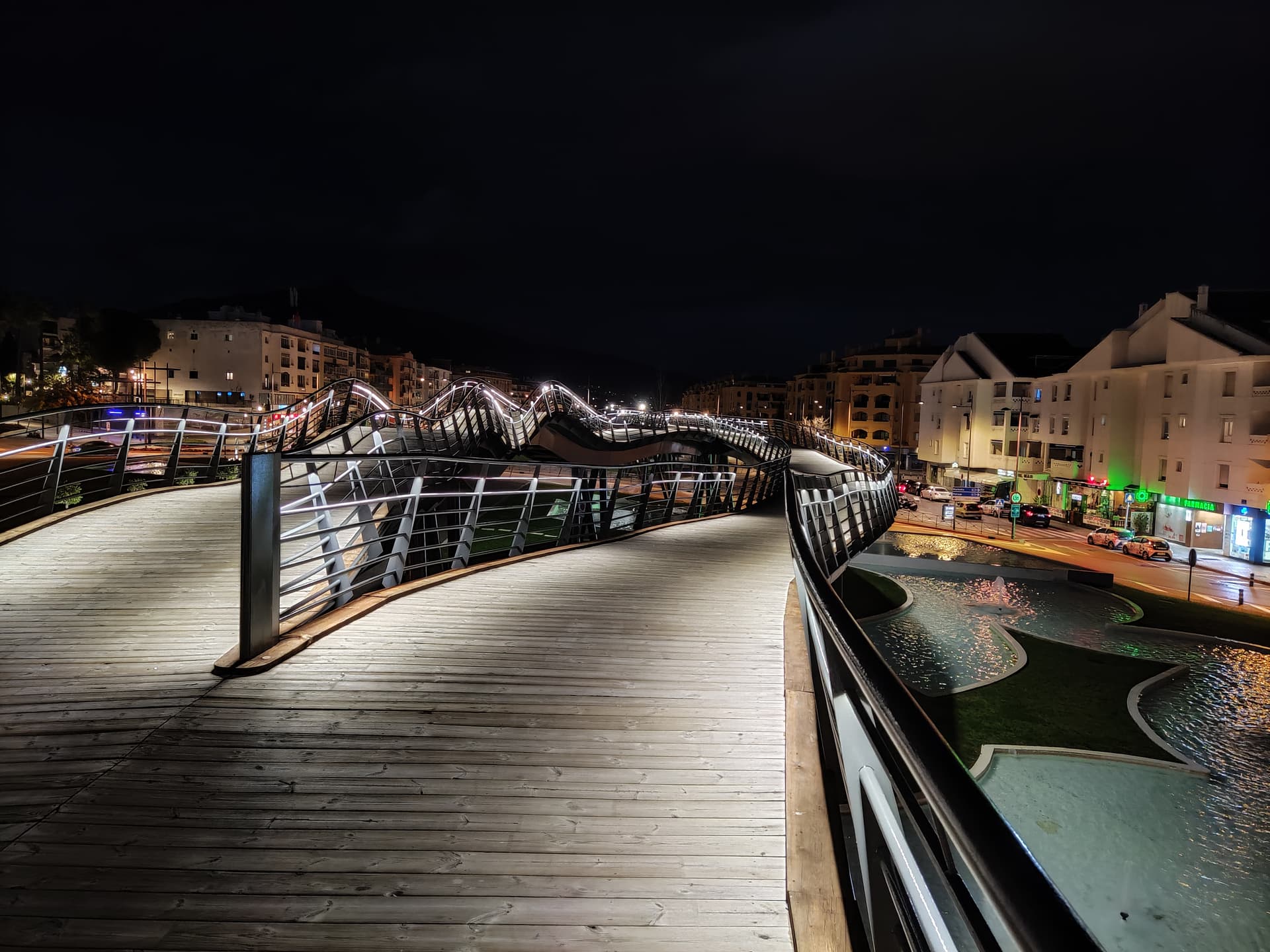
- Boulevard architect: Juan Antonio Fernández, who named the design Un Mar de Sensaciones ("A Sea of Sensations"), with the surface park undulating like sea waves
- Total project overrun: The Olive Press reported it ran "twice as long as planned and three times over budget"
- Marbella mayor Ángeles Muñoz called the opening a "big day" not just for Marbella "but for the entire Costa del Sol"
The effect on San Pedro was transformational. Before the burial, the coastal highway physically cut the town off from its own beach — a noisy, traffic-choked barrier that bisected the urban fabric. After the burial, the surface boulevard became a continuous green space connecting the old town through to the beach, with playgrounds, exercise areas, cafés, and open plazas.
4. The old town and the boulevard today
Walking San Pedro today, the central axis is:
- Plaza de la Iglesia — the historic central square, with the 19th-century church and open-air café seating
- Calle Marqués del Duero — the main pedestrianised shopping street, running north-south from the church toward the coast
- The Boulevard — the surface park over the buried highway, running broadly east-west and connecting the old town to the beach
- The Paseo Marítimo — the seafront promenade, part of the longer coastal walkway that connects west to Estepona and east to Puerto Banús
The combination gives San Pedro a walkable central spine that few Costa del Sol towns of its size match. Day-to-day life — from the morning market to evening restaurants — can happen on foot, which is not true of most of the Marbella-Puerto Banús coastal strip.
5. The property market
San Pedro's property inventory spans:
- Old town apartments — smaller, often older stock above the shops on Calle Marqués del Duero and the surrounding streets. Priced for functional living rather than investment; the value is walkability and daily Spanish life.
- Boulevard-adjacent apartments — benefited materially from the tunnel project. Pricing rose notably after 2014 as noise and traffic dropped out.
- Guadalmina Baja and Guadalmina Alta — the residential zones west of central San Pedro, running down to the coast. Guadalmina Baja is beachfront and includes some of the highest-spec villa stock in the municipality, with direct access to Guadalmina Golf and the Hotel Guadalmina Spa & Golf Resort.
- Nueva Alcántara — the quiet residential zone east of the centre, between San Pedro and Puerto Banús. Mostly apartment complexes with pool and garden, well-suited for family life within walking distance of San Pedro amenities.
Browse property for sale in San Pedro de Alcántara for current listings.
Pricing context: San Pedro generally runs 10–20% below equivalent Puerto Banús or central Marbella stock for comparable new or near-new apartment product, and the gap is larger for older resale stock in the old town. The trade-off is the town character — San Pedro feels more Spanish and less resort-polished than its neighbours.
6. Schools
San Pedro has one of the most important school clusters on the Costa del Sol:
- Laude San Pedro International College — full British curriculum, Early Years through A-Level, one of the larger international schools on the coast
- Colegio Atalaya — Spanish bilingual
- Colegio San José — Spanish-English bilingual
- Aloha College (in neighbouring Nueva Andalucía, 5 minutes away) — frequently chosen by San Pedro residents
The school concentration is a major driver of demand from families — particularly British, Scandinavian, and Dutch buyers whose decision often hinges on school access.
7. Golf
San Pedro sits at the eastern end of the New Golden Mile, surrounded by golf courses:
- Guadalmina Golf — two courses (Sur and Norte), directly west of central San Pedro
- Los Naranjos Golf Club — immediately east, in Nueva Andalucía
- Atalaya Golf — further west in Estepona municipality
- Marbella Club Golf Resort — inland, in Benahavís
8. Logistics and distances
- Puerto Banús: 3km east, 5–8 minutes
- Marbella town centre: 10km east, 15 minutes
- Estepona: 18km west, 20–25 minutes
- Málaga airport: 65km east, 55–65 minutes via AP-7
- Benahavís village: 5km inland, 10 minutes
The AP-7 toll road runs inland; the buried A-7 passes directly under the town. Bus services connect San Pedro to Marbella, Estepona, and on to Málaga and Málaga airport.
9. Who San Pedro suits
Strong fit:
- Families prioritising school access and walkable daily life
- Buyers who want a real Spanish town rather than a resort address
- Value-focused buyers looking at the Marbella area but wanting 10–20% below Puerto Banús pricing
- Residents who plan to live full-time rather than seasonally
- Long-term rental investors — the school-catchment demand is stable and year-round
Weaker fit:
- Buyers whose primary draw is the Puerto Banús lifestyle or the Marbella social scene
- Pure holiday-home seekers who want a resort rather than a working town
- Trophy-villa buyers — San Pedro's highest-end stock sits in Guadalmina Baja but the full trophy market is more concentrated in Sierra Blanca, Golden Mile, and La Zagaleta
10. FAQs
Is San Pedro part of Marbella? Yes — administratively San Pedro is part of Marbella municipality, though it retains a distinct identity with its own centre, character, and town council representation.
What happened with the A-7 tunnel project? The section of the A-7 coastal highway that cut through central San Pedro was buried in a 1km tunnel, with a surface boulevard park built over it. The Olive Press reported the cost at €85M — three times the original budget — with the boulevard opening in December 2014.
Why is San Pedro cheaper than Puerto Banús? Different character and demand profile. San Pedro is a working Spanish town; Puerto Banús is a marina-led resort destination. Property in San Pedro typically runs 10–20% below equivalent Puerto Banús stock.
Is San Pedro a good place for families? Yes. The cluster of international schools (Laude San Pedro International College and others), the walkable centre, and the post-boulevard green space make it one of the strongest family-buyer destinations on the Costa del Sol.
How walkable is the town? Very — for a coastal Andalusian town. The old town, the boulevard park, and the seafront can all be reached on foot from most central addresses.
Does San Pedro have a weekly market? Yes — a Thursday morning market runs year-round in the town centre, with a Saturday flea market in a separate location.