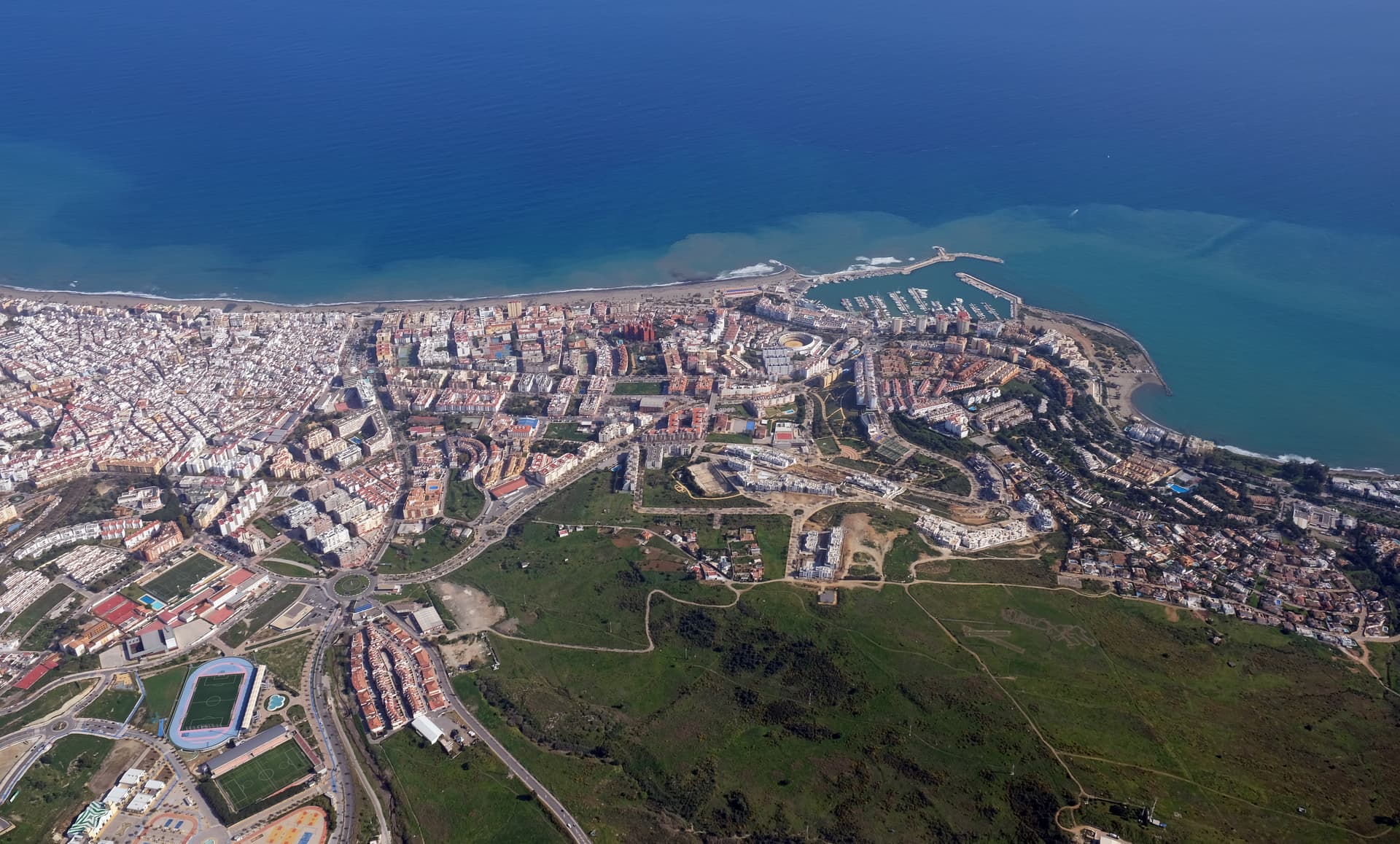
Estepona Area Guide
Estepona has spent the last decade reinventing itself. A coastal town 80km west of Málaga airport, it used to sit quietly in the shadow of its more famous neighbour Marbella. Today it's the fastest-growing municipality on the Costa del Sol, Spain's second-fastest-growing city by population, and the single largest source of new-build supply on the Western Costa del Sol. This guide covers how Estepona got here, what to expect on the ground, and what the property market looks like in 2026.
1. A short history — how Estepona went from quiet to essential
Estepona is an old Andalusian town, but its modern rise is recent. Since 2011, mayor José María García Urbano has run an ambitious urban-renewal programme: pedestrianising the old quarter, painting the historic houses, rebuilding the seafront promenade, and launching the Open-Air Art Museum mural programme in September 2012.
The town now has around 70 large-scale artistic murals commissioned from Spanish and international artists, including "Reflejos del jardín" — described as the largest vertical mural in Europe by a single artist, painted near the Botanical Gardens and Orchid House. The International Mural Competition received 116 proposals from a dozen countries in its most recent edition, anchoring Estepona's reputation as a Spanish reference point for urban art.
Beyond the murals, over a million flowers have been planted across the town, and streets have been steadily pedestrianised. The cumulative effect: a town that feels looked-after in a way few other Costa del Sol municipalities do.
2. Where Estepona sits on the map
Estepona occupies the Western Costa del Sol, with Marbella and San Pedro de Alcántara immediately to the east and Manilva / Sotogrande to the west. Málaga airport sits around 80km east — roughly a 55–70 minute drive via the AP-7 toll road or the slower A-7 coastal route. Gibraltar is 40 minutes to the west.
The municipality covers both coast and hillside. On the coast: Estepona old town, the port, the seafront promenade, and the 15km strip known as the New Golden Mile, running east along the coast toward San Pedro. Inland: hillside urbanisations like Los Flamingos, Selwo, and the higher estates that look south over the Mediterranean toward Africa on clear days.
3. The population boom
Estepona's 2024 population reached 78,413 — an increase of 10,127 residents since 2019. In 2023 alone, the town grew 4.6% — the single largest population increase of any Andalusian municipality that year.
Foreign residents drove 81% of that growth. The number of registered foreigners rose 15% in a single year — from 18,250 to 20,987. That proportion of international residents is among the highest of any significant Spanish town, and it shows up on the ground: the restaurant scene, the school system, and the property market are all oriented around a permanent non-Spanish population alongside the native community.
4. The New Golden Mile: the largest new-build pipeline on the coast
The New Golden Mile — the coastal strip from San Pedro de Alcántara west to Estepona town — is where most of the Western Costa del Sol's active new-build pipeline is being delivered. The combination of available coastal land, established infrastructure, and pricing roughly 20–30% below comparable new stock in Marbella proper has kept developers active through multiple cycles.
Typical new supply on the New Golden Mile takes the form of resort-style apartment and townhouse complexes with full amenity packages: outdoor and indoor pools, gym, Turkish bath, landscaped gardens, 24-hour security. Larger schemes add concierge, co-working, padel courts, and on-site dining. Build quality sits above older resale stock on most specifications — A- or B-rated energy certificates are now standard, ceiling heights run 2.7–3.0m, and underfloor heating, aerothermal systems, and smart-home pre-wiring come as default.
Browse live new-development listings in Estepona for current availability.
5. Estepona old town: the character-rich core
The town itself has become one of the most distinctive coastal old quarters on the Western Costa del Sol. Cobbled streets, painted houses, the Plaza de las Flores as the main square, and the Open-Air Art Museum murals scattered across otherwise-utilitarian side streets and plazas. The seafront promenade connects the port and the town beaches, extending east to the marina.
New construction in the town core is limited — most activity here is refurbishment of existing stock, not ground-up development. What does get built commands a premium over the New Golden Mile strip, because the town-core lifestyle (walkability, daily life in a genuinely Spanish setting) is a distinct and scarcer proposition.
6. Hillside Estepona: Los Flamingos, Selwo, Valle Romano
Inland of the coast, Estepona's hillside zones include the Los Flamingos estate — home to the Anantara Villa Padierna Palace hotel and its three golf courses — Selwo, and Valle Romano, each offering larger plots, longer sea views, and lower €/m² pricing than the beachfront. Drive times to the coast typically run 8–15 minutes.
These zones suit villa buyers who want space, privacy, and views rather than walkability. They're also strong rental-investment targets given the tourism draw of the golf resorts and the Anantara hotel.
7. The property market in 2026
Two useful reference points:
- New-build pricing: entry-point two-bed apartments in well-amenitied New Golden Mile schemes typically sit meaningfully below equivalent Marbella comparables. Beachfront stock and town-core developments command a premium over the generic strip.
- Resale pricing: Estepona resale inventory covers the full range — from compact town apartments through to significant beachfront villas. The spread reflects the town's mix of permanent-resident, second-home, and investor buyer profiles.
Browse resale property in Estepona for current listings with filters and prices.
Spanish property law on new-build transactions is national and applies identically here: mandatory bank guarantees on deposit payments, ten-year structural warranty under the Ley 38/1999 de Ordenación de la Edificación (LOE), and a First Occupation Licence requirement at completion.
8. Who Estepona suits — and who it doesn't
Estepona works well for buyers who want:
- Modern new-build quality at prices below Marbella
- A real Spanish town as daily backdrop rather than a resort strip
- Large terraces and community amenities in apartment product
- Rental-investment exposure with strong tourism demand
- Access to Gibraltar and the western airport routes
It suits less well when:
- The primary draw is Puerto Banús or the Marbella social scene — you'll be driving 15–25 minutes east for those
- Access to international schools is the deciding factor — the largest cluster sits in Marbella, not Estepona
- The buyer specifically wants a trophy Marbella address
9. Daily life and amenities
The town has a full services footprint: a public hospital, multiple private clinics, major supermarket chains (Mercadona, Carrefour, Lidl), a working fishing port, the weekly Wednesday market, and — crucially — a cultural programme supported by the municipality that runs year-round rather than seasonally.
Golf: the wider area hosts Valle Romano Golf, Estepona Golf, Atalaya Golf, the three Anantara Villa Padierna courses, and Finca Cortesín — the latter a regular host of European Tour events.
Beaches: 23km of coastline across Estepona municipality, including Playa del Cristo, Playa de la Rada (the main town beach), and Costa Natura (Spain's first naturist beach, at the western end).
10. Practical logistics
- Málaga airport: 80km east, 55–70 minutes via AP-7
- Gibraltar airport: 40km west, 40–50 minutes
- Marbella: 20km east, 20–30 minutes
- Puerto Banús: 15km east, 15–25 minutes
- Ronda: 60km north, 1 hour 10 minutes inland drive
The AP-7 toll road runs parallel to the coast inland; the free A-7 runs directly through town. Both feed into the wider Costa del Sol network.
11. FAQs
Is Estepona cheaper than Marbella for property? Yes — typically 20–30% below Marbella core for comparable new-build specification, with the gap largest on the New Golden Mile strip and narrowing for town-core and beachfront stock.
What is the New Golden Mile? The coastal strip between San Pedro de Alcántara and Estepona town — around 15km — which is the largest active source of new-build supply on the Western Costa del Sol today.
Does Estepona have good restaurants and nightlife? A strong and growing restaurant scene, particularly in the old town and along the port. Nightlife is lower-key than Puerto Banús — more wine bars and late restaurants than clubs.
How long does it take to drive to Málaga airport? Around 55–70 minutes via the AP-7 toll road depending on traffic. The A-7 coastal route runs longer but is free.
Is Estepona a year-round town or is it seasonal? Year-round. The permanent resident base, including the large foreign-resident population, keeps services, dining, and cultural programming running through winter rather than shutting down after the summer season.
What's driving the population growth? Per municipal and INE data, 81% of recent growth has come from new foreign residents. The combination of relative affordability versus Marbella, the town's urban-renewal programme, and strong remote-work-friendly infrastructure has made Estepona one of the most consistently growing municipalities in southern Spain.
Sources
- Olive Press — Costa del Sol in bloom: Malaga towns dominate ranking of Spain's fastest growing population centres
- Euro Weekly News — Nearly 3,000 more foreigners in Estepona
- Easy Estepona — The Murals Route in Estepona
- Real Estepona — International Mural Competition
- Andalucia.com — Murals on Estepona Apartment Blocks
- Invest in Spain — Fastest-growing populations of Spanish cities
- INE — Municipal Register (Padrón)